Announcement
Fronte Raises Pre-Seed Co-Led by Rally Cap VC and Bankless Ventures
We’re building the financial operating system for transnational families — starting with the household itself.

Excited to announce that Fronte has raised its pre-seed financing, co-led by Rally Cap VC and our friends at Bankless Ventures, with participation from the Base Ecosystem Fund and a group of fintech founders, operators and angels.
We’re building the financial operating system for transnational families around what we think is a fundamental mismatch in how the category has developed: migration is an economic strategy at the household level, while financial products, data and underwriting still resolve almost entirely to individuals and transactions.
The remittance industry has spent decades optimizing speed and cost for the sender; more recently, wallets and stablecoin neobanks have focused on giving recipients better access to dollars. Both have created real value, but neither changes the underlying abstraction. A family may earn income across several countries, have multiple people funding the same recurring obligations and demonstrate years of financial reliability, while the financial system continues to see unrelated users and transfers.
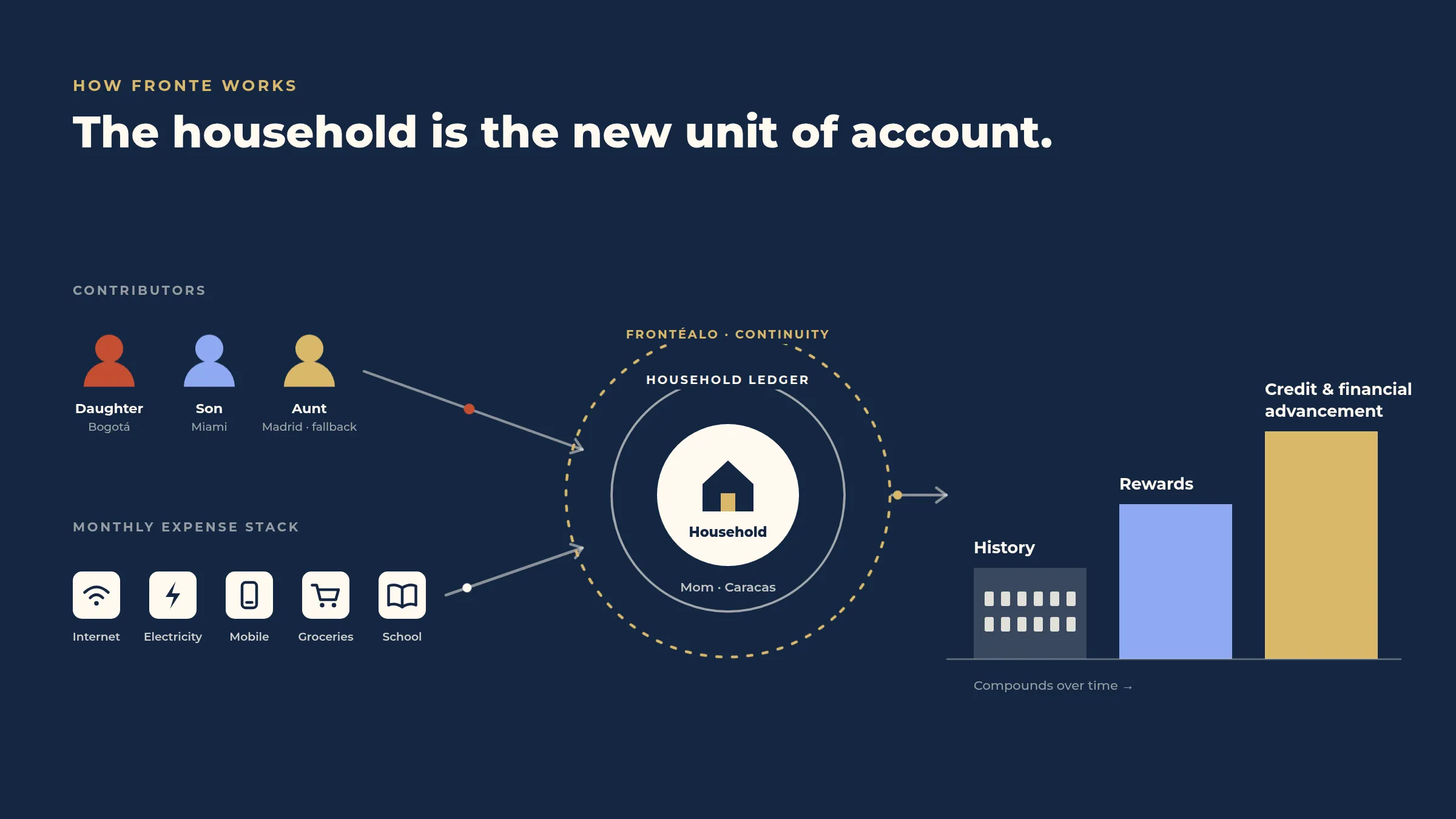
Fronte is building the household itself as a new financial unit of account — organizing recurring expenses, contributors, payments and fallback support in one system, rewarding behavior that strengthens the household, and using that history to unlock credit and broader financial advancement over time.
More than $685 billion in officially recorded remittances flows into low- and middle-income countries annually; our view is that the larger opportunity is not another layer of optimization around the transfer, but the financial infrastructure and products that can finally sit around the family it supports.
A complementary cap table
One of the biggest lessons from building Rally Cap has been the value of a complementary cap table, especially early when investors can bring much more than capital.
Rally Cap has spent the last several years operating and investing across emerging-market fintech; Bankless brings deep experience across stablecoins, wallets and on-chain infrastructure, along with a view we share that the best consumer products will hide most of that complexity; and Base is helping build the programmable, low-cost settlement infrastructure that makes global financial applications increasingly viable.
Around them, we’ve added operators and advisors across remittances, wallets, credit, growth and financial infrastructure. For a company sitting somewhere between application, financial infrastructure and multi-market orchestration, that combination is extremely useful.
From infrastructure to a different application layer
The thesis behind Fronte goes back much further for me. I studied economic development in college and wrote my thesis on collectivized remittances in rural Mexico, spent time doing humanitarian work with migrants on the U.S./Mexico border, and then spent most of the next decade around different versions of the same problem — prepaid airtime-based credit-building at Juvo, emerging-market credit and expansion at Migo, payments infrastructure and market strategy at Libra (Meta), and eventually investing across many of those categories through Rally Cap.
A core premise behind Rally Cap was that my years operating in emerging markets had been defined by frustratingly incomplete financial rails. You could have a compelling consumer idea and still spend years stitching together banks, cards, KYC, payouts, FX, treasury, licensing and whatever local infrastructure existed in each country. Stablecoins, real-time payments, banking APIs and AI have changed that dramatically, and I still believe a lean, AI-native team can operate across markets in a way that would have been nearly impossible a decade ago.
But as a VC, I have no delusions about what that has produced. We watch extremely well-funded neobanks, remittance companies, stablecoin wallets and global financial apps compete aggressively for many of the same consumers. A lot of them are very good products, backed by enormous amounts of capital, and we have zero interest in trying to outspend them on CAC to offer another version of faster, cheaper remittances or easier dollar access.
We’re taking a different approach: owning a financial relationship those products generally do not model at all — the household itself.
Building the household financial layer
Better primitives also do not mean the system we need already exists. The financial stack is still overwhelmingly built around one person, one account and one balance. Fronte needs to understand that Mom manages the household in Venezuela, her daughter in Bogotá usually pays the internet, her son in Miami handles electricity, another family member can step in when somebody is short, and that years of this behavior should compound into something financially useful. There is no off-the-shelf account structure, ledger or underwriting primitive that does that.
That is why a meaningful part of Fronte is infrastructure rather than simply an app assembled from other people’s APIs. At the center is our household ledger, which turns recurring obligations into structured financial objects: what needs to be paid, when it is due, who normally funds it, who can act as fallback, how it was resolved and what happened when something broke. Cards, bank transfers, stablecoins, wallets and bill-pay providers can change market by market; the household and its financial history persist above them.
The first behavior we organize is what we call the Monthly Expense Stack — electricity, internet, mobile data, groceries, school, healthcare, rent and the other must-pays that keep a household functioning. These are already being funded every month, often by several family members, but the coordination mostly happens through WhatsApp, screenshots, transfers, memory and favors.
In our research across roughly 1,000 remittance-engaged households, about two-thirds relied on two or more active financial contributors, while 46% had been explicitly denied credit despite consistent family support. What looks like fragmented remittance activity at the transaction level starts to look a lot more like recurring household income once you model the family correctly.
On top of that ledger sits our continuity engine, Frontéalo. Prepaid gives consumers control, but it is unforgiving: if the money isn’t there at the right moment, the data runs out or the service gets cut. Traditional postpaid provides continuity, but often brings contracts, fixed obligations, penalties for falling behind and the anxiety of committing to a bill you may not know you can cover every month.
Frontéalo is designed to sit between those models — preserving the flexibility of prepaid while adding the continuity of postpaid. If an obligation comes due and the expected funding isn’t there, Fronte can coordinate across the family, pull in an agreed fallback contributor, switch funding methods and, as sufficient history develops, potentially bridge qualifying timing gaps directly.
That history is ultimately the point. People migrate in large part to create more economic opportunity for themselves and their families, yet years of successful migration and recurring family support often produce remarkably little formal financial advancement for the household receiving it. We want Fronte to change that.
Families should be rewarded for routing activity they already have through Fronte — adding recurring expenses, paying consistently, bringing in contributors and reliably supporting one another — and that behavior should compound into something of value. More history should allow us to offer stronger continuity, better rewards and eventually financial products the traditional system cannot underwrite today.
Credit is not a monetization layer stapled onto a wallet; it is one of the core reasons to build the system in the first place.
Why Bogotá, and the team we’re building there
Colombia is a compelling place to build from: roughly $12 billion in annual remittances, one of Latin America’s strongest fintech talent pools, and more than 2.8 million Venezuelans maintaining family and financial ties across Colombia, Venezuela, the U.S., Spain and elsewhere. For us, that complexity is a feature. We want to prove the architecture where banking, identity, currencies and payment rails are genuinely fragmented; if Fronte only works in easy markets, we haven’t solved the problem.
We’ve built the team in Bogotá around that challenge. Fredo Dacosta leads product after roughly five years at Nubank across Colombia, Mexico and Brazil, with Daniel Olarte, previously at Celo and BlockRadar, leading ecosystem and expansion; we then have Andrés Montaño, ex-Addi, on credit; Valentina Aguirre, ex-EVEN, on product design, and Daniel Osorio, ex-Treinta, on GTM.
Vuong Nguyen, ex-CTO at Conduit, came in early and built Fronte’s 0→1 AI-native architecture, hired the initial engineering team and established much of the core ledger and infrastructure approach. Engineering is now led by Lasha Kvatashydze, previously at Conduit, who is taking that foundation forward with a team that brings deep payments and infrastructure experience.

The goal is to stay unusually senior and lean, use AI and modular infrastructure wherever they genuinely provide leverage, and own the pieces — particularly the household account, ledger and continuity engine — that we think can become durable IP.
What comes next
We’ll continue adding selectively as we build toward a Seed in Q1 2027, especially around mass-market consumer growth, technical leadership and payments/integration work.
If you’ve helped take a wallet, neobank or mass-market fintech from zero to meaningful adoption in an emerging market; know how to acquire users through communities and referrals rather than simply buying installs; or have spent an unreasonable amount of your career thinking about ledgers, payment orchestration, cards and cross-border fund flows, we’d love to hear from you.
And if you’re an investor who has spent time thinking about migration, remittances, stablecoins, consumer credit or what the next application layer on top of modern financial infrastructure should look like, always happy to compare notes.
More soon.
— Hayden Simmons, Founder, Fronte
Fronte is building the financial operating system for transnational families. Learn more at frontepay.com.